Walk through any furniture showroom in Brevard County and you will hear the same word over and over: quality. Most of the time, it means nothing — it's the marketing default for anything priced above the bargain rack. But after years on Harbor City Boulevard, I've watched what holds up in Florida humidity and what falls apart inside three years. The difference, almost without exception, is whether the piece was built in the United States.
Brevard is a tough place on cheap furniture. Salt air finds the cut edges of imported plywood. Humidity swells veneer and pops glue joints. Sun fades synthetic fabric the moment a curtain stays open one summer afternoon. None of that is hypothetical — it's what we see when a customer asks us why their three-year-old sectional from a big-box store has cushions that lean to the left and a frame that creaks every time someone sits down.
This is a buyer's guide for that customer, and for anyone in Melbourne, Indialantic, Cocoa Beach, Viera, or anywhere along the Space Coast who is ready to stop replacing furniture every few years. Atlantic Fine Furniture carries more than a thousand American-made pieces. Here is what we've learned about what to look for, and why seeing it in person matters more than any photograph online can show you.

Why "Made in USA" Actually Matters
The label by itself doesn't mean much. What matters is what the label points to: a set of construction choices that cheap, imported furniture quietly skips. Once you know what those choices are, "Made in USA" stops being a marketing phrase and starts being a useful filter.
Kiln-dried domestic hardwoods vs. air-dried imported softwoods
Furniture frames hold their shape because the wood inside them is dry — about 6 to 8 percent moisture content. American hardwood mills kiln-dry their lumber to that spec. Many overseas factories don't, or don't do it consistently. The result, two summers into a Florida home: drawers stick, joints loosen, and screws back themselves out of softwood frames that swelled and contracted through humidity cycles.
Eight-way hand-tied springs vs. webbing or sinuous wire
Underneath every sofa is a suspension system. The premium standard is eight-way hand-tied — coil springs anchored to the frame and tied to each other with twine in eight directions. It is slow, expensive, and it lasts 20 years. The budget alternative is rubber webbing or zigzagging steel wire. Both work fine on day one. By year five, the webbing has stretched and the cushions sit two inches lower than they did when you bought them.
Foam density you can actually verify
American upholstery factories will tell you the density of the foam in their cushions: 1.8 pounds per cubic foot is solid; 2.0 is excellent. Cheaper foam, often labeled "high-density" without any number attached, can come in at 1.2 or below. It feels great in the showroom and turns into a saggy pancake by the second football season.
Factory accountability
This one is harder to put a number on, but it matters. When a Capris sectional has a problem, we can call them in Ocala and reach a person who knows the piece. When a piece from an unnamed overseas factory has a problem, the warranty path runs through a 1-800 number, a freight quote, and a 12-week wait. We've watched both unfold in our customers' homes.
The Categories Where It Matters Most
Not every piece in your house has to be American-made. Side tables, lamps, accent pieces — there's a thoughtful place for imported furniture. But for the foundational pieces that hold weight or take daily use, the construction differences compound. Here's where we'd spend the money.
Sofas, sectionals, and sleepers
This is the single highest-leverage category. A sofa is sat on, slept on, jumped on by grandchildren, and exposed to your skin every evening for a decade. Frame, suspension, foam density, and fabric grade are all the difference between a piece that improves with use and a piece that quietly degrades.
Bedroom sets
Solid hardwood holds up to humidity. Veneer over particleboard does not. The tell is weight: a real American-made dresser is heavy, because the drawer sides are solid maple or oak, not laminated MDF. Open and close every drawer in the showroom. The good ones glide; the cheap ones grind.
Dining tables
A dining table is a flat piece of wood under daily use. Wood movement, joinery, and finish quality decide whether the surface still looks good in ten years or shows every plate scrape and water ring. Domestic hardwood with mortise-and-tenon joinery is the bar.
Upholstered chairs
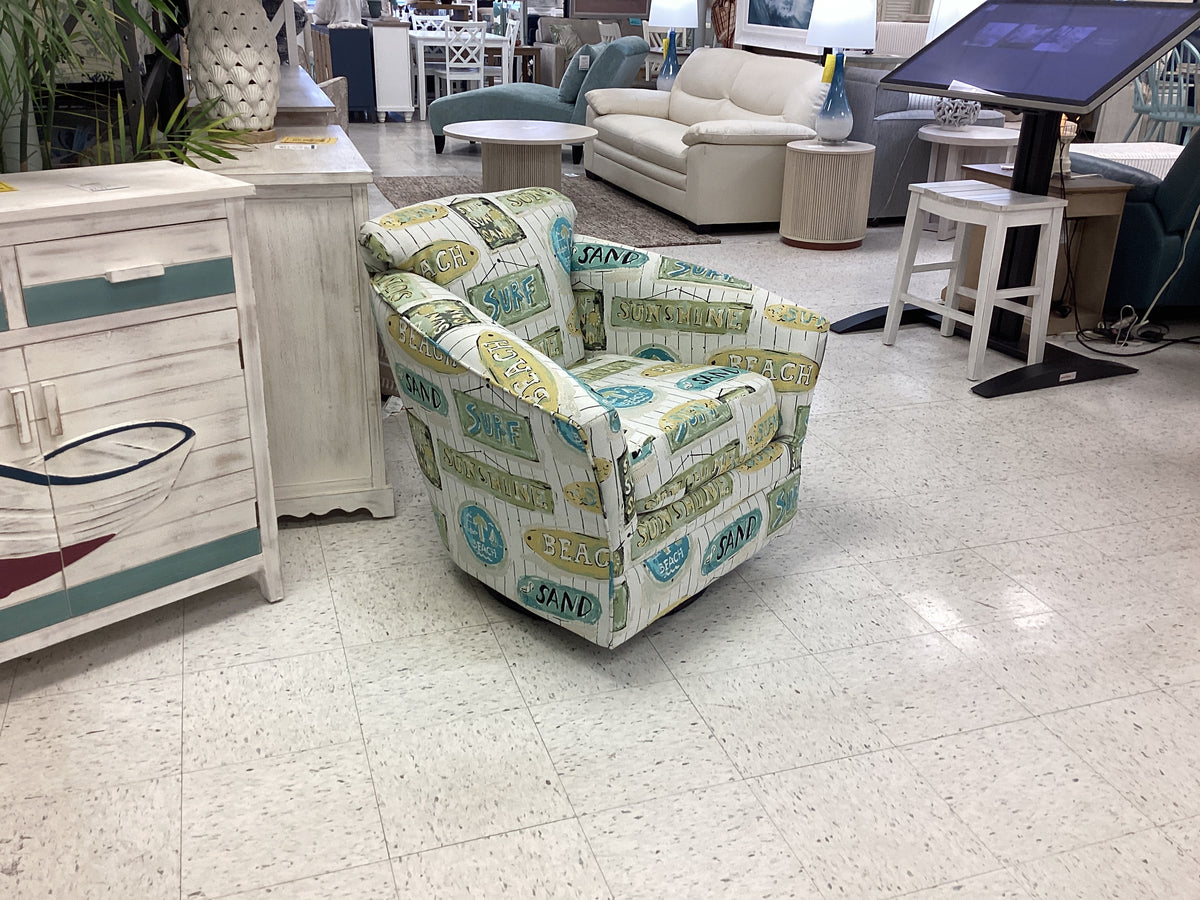
Same logic as sofas, with a tighter geometry. Frame strength matters more in armchairs because the load is concentrated in fewer joints. American factories like Stanley Chair build with corner-blocked, doweled hardwood frames that don't squeak when someone leans hard on the arm.

The American-Made Brands We Carry
We've been adding to our American-made bench for the better part of two decades. Here are the names we'd recommend most often, and what each does best.
Ocala, Florida
Capris Furniture
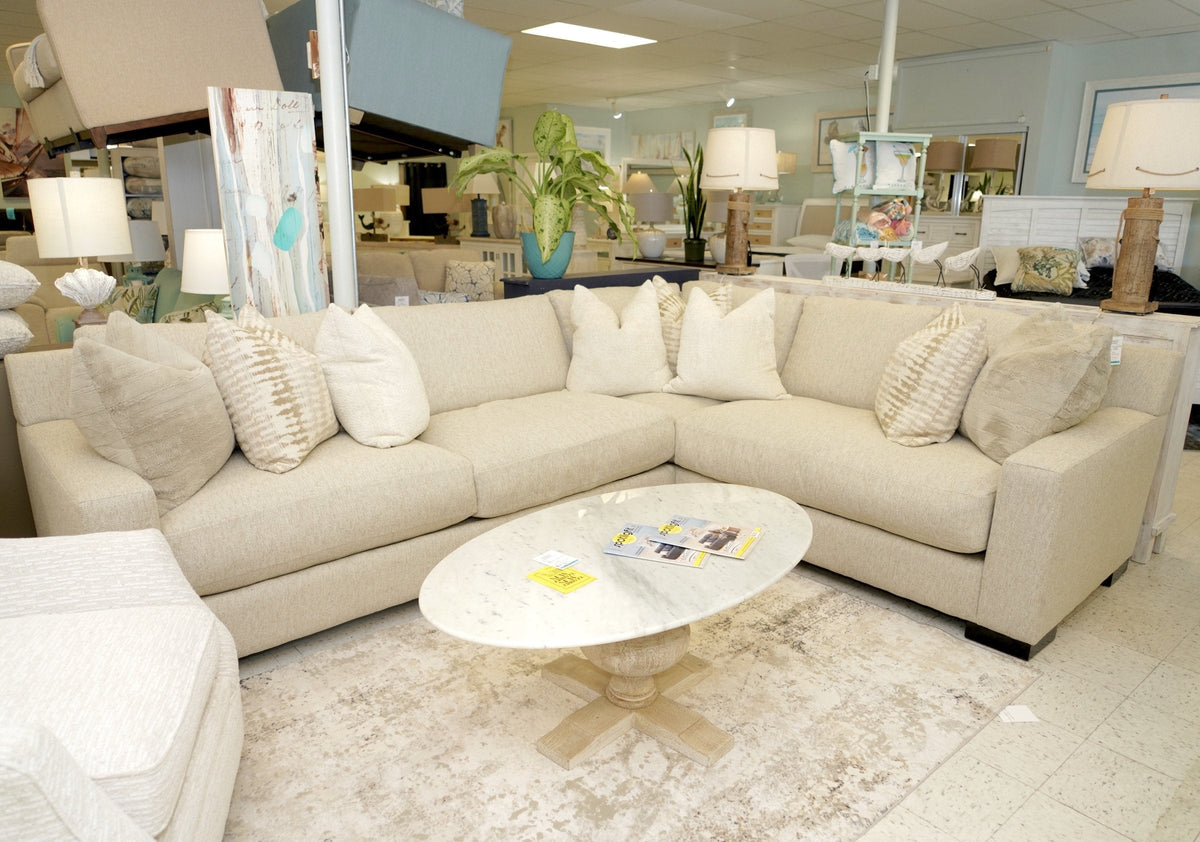
Custom upholstery built one piece at a time, in our own state. Corner-blocked hardwood frames, eight-way hand-tied springs available, your fabric choice from hundreds of options. Florida-built, for Florida homes.
Iowa, since 1893
Flexsteel
The patented Blue Steel Spring is a single ribbon of high-carbon steel that runs the length of the seat. It carries a lifetime warranty and is the reason your grandmother's Flexsteel still sits like the day she bought it.
Georgia
John Michael Designs
Heirloom-grade upholstery. The Double Chaise sofa is a showroom favorite — every seam, every cushion, every leg specified individually.
Tampa, Florida
Stanley Chair
Custom swivel gliders, recliners, accent chairs, and sofas. The kind of pieces a customer will keep through three sofas because the chair outlasts everything around it.
Florida-designed, US-built
Sea Winds Coastal
Coastal bedroom collections — Islamorada, Surfside, Geneva — that look the way Florida should feel. Solid wood, weathered finishes, built for a humid climate.
Various US factories
And many more
More than 1,000 American-made pieces across bedroom, dining, living, and office. The full collection is a click away — or, better, a short drive.
See what 1,000+ American-made pieces actually looks like.
Shop the Made in America CollectionWhat to Feel for in Person
Photographs hide things on purpose. The frame inside a sofa, the spring system under the cushion, the way a drawer feels at the back of its track — none of that comes through in the listing. Here is the short list of things we'd run through every time we walk a customer through the showroom.
The Showroom Checklist
- Push down on the cushion. Hard. Then let go. Good foam (1.8 lb density or higher) bounces back to its full height inside a few seconds. Cheap foam stays compressed.
- Lift one corner of the sofa or sectional. A solid hardwood frame is heavy. If it lifts easily, the frame is engineered wood or hollow softwood. That matters more than fabric color.
- Open every drawer. All the way out. Solid wood drawer sides feel different from MDF. Glide should be smooth front to back. If it sticks at the back of the track, the cabinet is racked or under-built.
- Look at how seams meet at corners. On upholstery, seams should align at the corners of cushions and arms. Misaligned seams mean rushed work, which usually means rushed everything else.
- Smell the piece. Domestic kiln-dried hardwoods don't off-gas. If you walk into a furniture department and immediately smell the furniture, that is glue and finish from materials that weren't fully cured before shipping.
- Sit for at least ten minutes. The first 30 seconds of a sofa flatter every sofa. The next 10 minutes are where you find out whether the support holds, whether the lumbar feels right, whether you'd actually want to read a book on it.
Eric's Take
After thirty years in this business, the most common thing I hear from customers who got it wrong the first time is, "It looked great in the photos." Photos are sales tools. Showrooms are diagnostic tools. The thirty minutes it takes to drive here and sit on a sofa is the cheapest insurance you can buy on a $3,000 piece of furniture.

The Brevard Reality — Why a Showroom Visit Beats an Online Cart
If you live anywhere on the Space Coast — Indialantic, Satellite Beach, Indian Harbour Beach, Cocoa Beach, Vero Beach, or any of the inland neighborhoods from Palm Bay to Titusville — you live in a climate that punishes shortcuts in furniture construction. Salt air, humidity, summer thunderstorms that drive humidity to 90 percent inside a week, and afternoons of unfiltered sun through hurricane-rated windows. Furniture that survives that environment is built differently than furniture for, say, a Denver dry-air house.
This isn't theoretical. We deliver across Brevard six days a week, and we hear from customers years after the sale. The pattern is consistent: American-made upholstery, with proper foam density and frame construction, is still in use a decade in. Cheaper imported pieces — even ones that cost 70 percent of the American-made equivalent — are usually replaced within five years. Over a fifteen-year horizon, the more expensive piece is the cheaper option, which is the actual math nobody runs at the point of purchase.
The other reason the showroom matters is the buyer archetype we see most often. A retired couple from Ohio, a vacation-home owner in Indialantic, a Viera family with a brand new house. Each of them has a specific room, specific dimensions, specific needs. Twenty-five minutes with our team — Maya, Jenna, or Stephanie — usually saves them six weeks of online second-guessing and at least one return shipment.
Frequently Asked Questions
Is American-made furniture worth the price difference?
For pieces that hold weight or take daily use — sofas, beds, dining tables, upholstered chairs — yes, almost always, on a 10-year horizon. For accent pieces and decor, the calculus is different. We'd rather see a customer spend their budget on the foundational pieces and accent the room with imports than the other way around.
How can I tell if furniture is actually made in the USA?
Two ways. First, ask the salesperson where the factory is and what state it's in. A real answer comes quickly; vague answers come slowly. Second, look at the frame label and any documentation that ships with the piece — American factories almost always declare it. If neither path produces a clear answer, assume the piece is imported.
What's the difference between "solid wood" and "all-wood construction"?
"Solid wood" means the structural pieces are cut from real lumber, no veneer over composite. "All-wood construction" is a softer claim that can include engineered wood and high-density fiberboard. Both terms have their uses, but for primary surfaces — table tops, drawer sides, bed rails — "solid wood" is the spec to ask for.
Does American-made upholstery actually last longer in Florida humidity?
The construction does. Kiln-dried hardwood frames, properly cured glue, and higher-grade foam handle humidity cycles that swell cheap furniture. Fabric matters too — performance fabrics with a high double-rub count handle salt and sun better than thin imports. If you live within five miles of the beach, ask specifically about performance fabric grades.
Can I order American-made furniture custom?
Yes — and on certain lines, custom is actually the same lead time as in-stock. Capris and Stanley Chair, for example, build to order. You pick the frame, the cushion fill, the fabric, and the leg style. The piece arrives in 8-10 weeks, configured for your room. We do this regularly for vacation-home owners furnishing condos in Cocoa Beach or Indialantic.
How long does delivery take vs. imported furniture?
Counterintuitively, often faster. American factories ship to our warehouse on a regular cadence and we deliver locally — usually within two weeks of order for in-stock pieces, 8-10 weeks for fully custom. Imported furniture has the appearance of being faster because it sits on a cargo ship, then in a port, then in a regional warehouse. The total time from order to your living room is often longer, with less visibility along the way.
Does Atlantic Fine Furniture deliver American-made furniture statewide?
Yes. We deliver across Brevard County daily, statewide Florida weekly, and offer select nationwide shipping for larger orders. Our delivery team — Jordan and Chris — handles white-glove setup, which on American-made pieces matters more than people expect. (Try setting up an eight-way hand-tied sleeper sofa by yourself and you'll see what I mean.)

Come see what 1,000+ American-made pieces actually feels like.
Half an hour in our Melbourne showroom is the cheapest research you'll do.
Atlantic Fine Furniture & Mattress
1024 S Harbor City Blvd, Melbourne FL 32901
Mon–Sat 10am–6pm · Sun Closed