Two objections arrive together often enough that I have started treating them as one: "Will it look cheap in my living room?" and "What happens when we sell the house?"
Underneath both is the same question. What does this thing signal about my home?
Some of them do look cheap
Let me start there, because the concern is not imaginary.
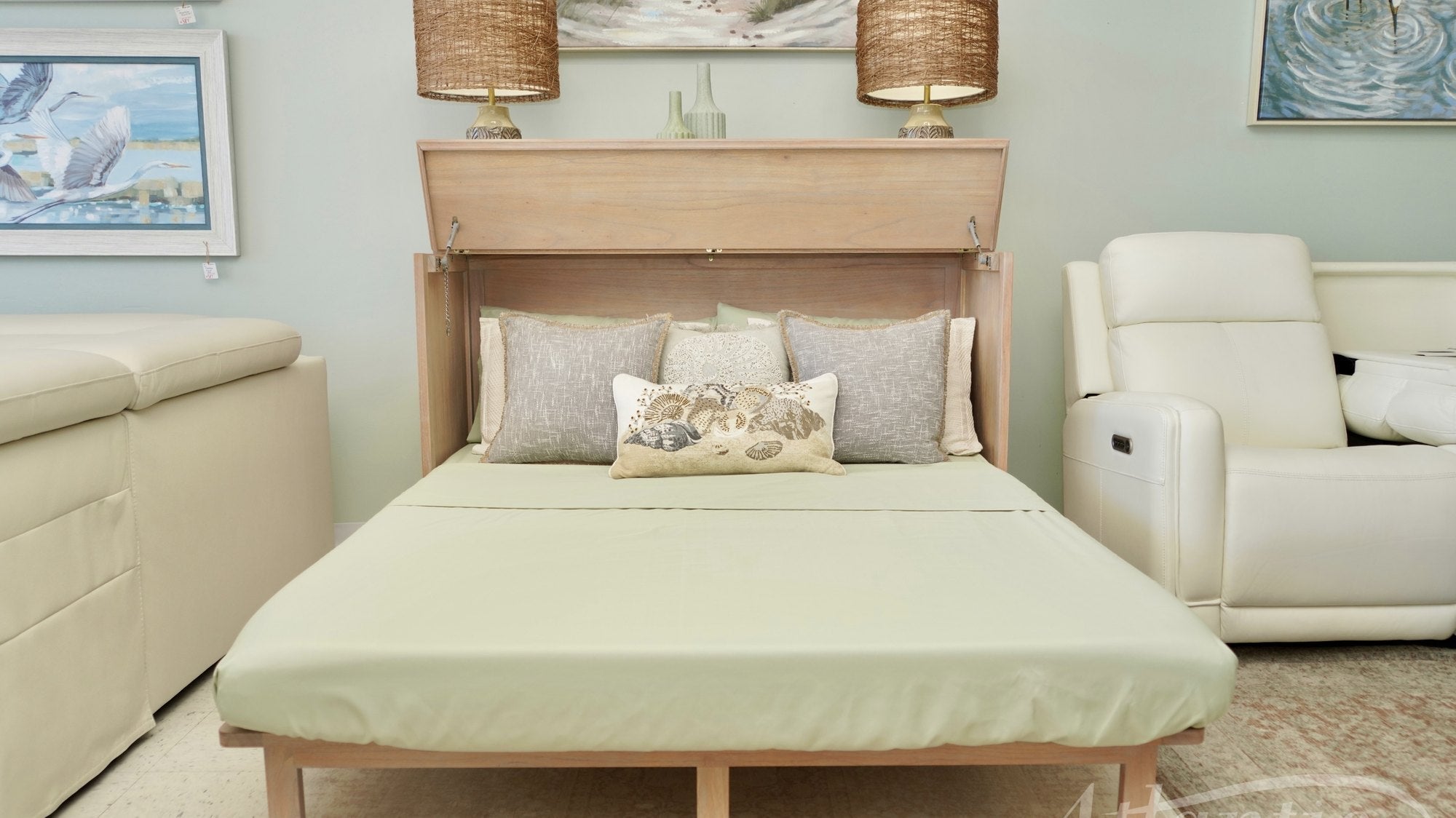
The image most people have in their head is accurate to a real product: a boxy laminate cabinet with a shallow, oddly proportioned drawer across the bottom that does not quite match anything, sitting in a room where it plainly does not belong. That unit exists. It is most of what shows up when you search the category online, and it is why the objection is so common.
Three things separate a cabinet bed you would keep from one you would apologise for.
Material. Solid hardwood versus engineered panel. You can see it in the edges and the door faces, and in Florida you will eventually feel it in how the piece handles humidity.
Drawer proportion. This is the giveaway. On a well-designed cabinet bed the storage drawer reads as a deliberate part of the furniture. On a cheap one it reads as the leftover space beneath the mechanism, because that is what it is.
Finish and hardware. Real finish depth, pulls that match the piece, doors that line up when closed. The same details that separate a good sideboard from a flat-pack one.
Get those three right and nobody identifies it as a bed. Which is the actual test.
The test that matters
A cabinet bed spends the overwhelming majority of its life closed. So the honest question is not whether the bed looks good — it is whether the cabinet earns its place in the room on the days nobody is visiting.
The good ones do double duty without announcing themselves. A console under a television. A sideboard in a dining room. Storage along a hallway wall.
If a guest can sit in the room for an evening without working out what it is, the design has done its job.
What happens when you sell the house
This is where cabinet beds hold a genuine structural advantage, and it is worth understanding before you choose between the two categories.
A wall-mounted Murphy bed is a fixture. It is attached to the house, it usually conveys with the house, and some buyers react badly to it — a built-in bed reads as a compromise about the room, and a certain kind of buyer walks into that room and mentally subtracts value. You may be delighted with it for a decade and still find it working against you on the day you list.
A cabinet bed is furniture. It is not attached to anything. It does not convey, it does not appear on an inspection, and it does not shape a buyer's impression of the room, because on the day of the showing it is a console.
Then you put it on the truck and it becomes the guest bed in your next house.
That is not a small distinction. It is most of the reason people who considered both end up here.
The showroom test
Photographs are not much help with this one, because photographs are exactly where the cheap units look best and the good ones look ordinary. Finish depth, drawer proportion and how doors sit when closed are all things your eye resolves instantly in person and poorly on a screen.
We keep thirteen on the floor from all five American makers, closed, in room settings, at 1024 S Harbor City Blvd in Melbourne — directions here. Walk past them before anyone opens one. The ones that read as furniture will be obvious, and so will the difference between makers.
If cost is the live question, the market bands are here. If you are still deciding whether the category earns a place at all, that is this one. Everything we carry is on the cabinet bed page.
If you would rather compare the whole category in one place, every model on our floor is measured side by side in the cabinet bed comparison table.
Eric