The question is usually asked sideways. People say "how long do these last?" but what they mean is: am I buying a mechanism that will fail in three years and leave me with an expensive cabinet full of a broken bed?
It is a fair fear. Anything that folds has more ways to go wrong than something that does not. So here is what actually determines whether a cabinet bed lasts, and how to judge it before you buy rather than after.
Four things decide it
What the box is made of
This is the big one, and it is the one you can check yourself in about ten seconds.
A cabinet bed carries real load — the mattress, the platform, and two adults — through its own case. Particle board and engineered panel hold fasteners poorly under repeated load. Screws work loose at the joints, joints develop play, and play in a folding mechanism is what eventually turns into a failure. In Florida there is a second problem: panel products swell where moisture reaches an unsealed edge, and once a panel swells it does not go back.
Every cabinet bed on our floor is solid wood — hardwood on most models, solid Mindi on the rest. Not one of them is particle board. That is not a marketing line; it is the specification on every model, and it is listed model by model in the comparison table.
Whether it arrived assembled
Under-appreciated, and a genuine source of early failure.
A flat-packed cabinet bed is assembled by whoever bought it, usually once, usually without a torque driver. Over-tightened fasteners strip their seats; under-tightened ones let the case rack slightly every time the bed opens. Neither shows up on day one. Both show up in year two as a mechanism that binds or sits crooked.
Most of the models we carry arrive assembled and are placed by our own crew, which removes that whole failure category before it starts.
The lift mechanism, and the honest trade-off
Two designs are common, and we keep both on the floor.
Hydraulic lift uses gas struts to take the weight, so opening and closing is nearly effortless. Gas struts are also the one component in this category that is genuinely consumable — they lose pressure over years of use. The good news is that they are a designed-to-be-replaced part, not a structural failure, and replacing one is a service call rather than a new bed.
Manual folding has no struts at all. There is nothing to lose pressure because there is no pressure. Fewer parts, less to service, and a mechanism that is difficult to wear out. The trade is that you do the lifting.
Neither is better in the abstract. If the person opening it is strong enough and you like simplicity, manual folding is arguably the more durable design precisely because it has less in it. If lifting is a concern, hydraulic is worth the consumable.
Load margin
Our models list weight capacities of 500 to 600 pounds. Two adult guests are commonly around 350. Designing to roughly twice the expected load is what keeps a structure from working itself loose over years, and it is why capacity is worth reading even though you will never approach the number.
What the warranty is really telling you
A warranty is not a promise that nothing will go wrong. It is a manufacturer publishing, in writing, how long they expect their own product to survive. Read that way it is the most useful durability signal available before you own the thing.
Across our floor, ten models carry a limited ten-year manufacturer warranty on the cabinet. Most of the rest carry a five-year extended warranty that we include. Terms are listed per model, and the model's own page is the authority.
The more revealing question is not the number of years. It is what happens when you call. Ask any seller — including us — three things: who actually performs the service, whether the mechanism components are replaceable, and how long parts take to arrive. A ten-year warranty from a business with no local presence and no service crew is a customer service phone number, not a repair.
What to check, standing in front of one
Six things, two minutes, and they tell you more than any spec sheet.
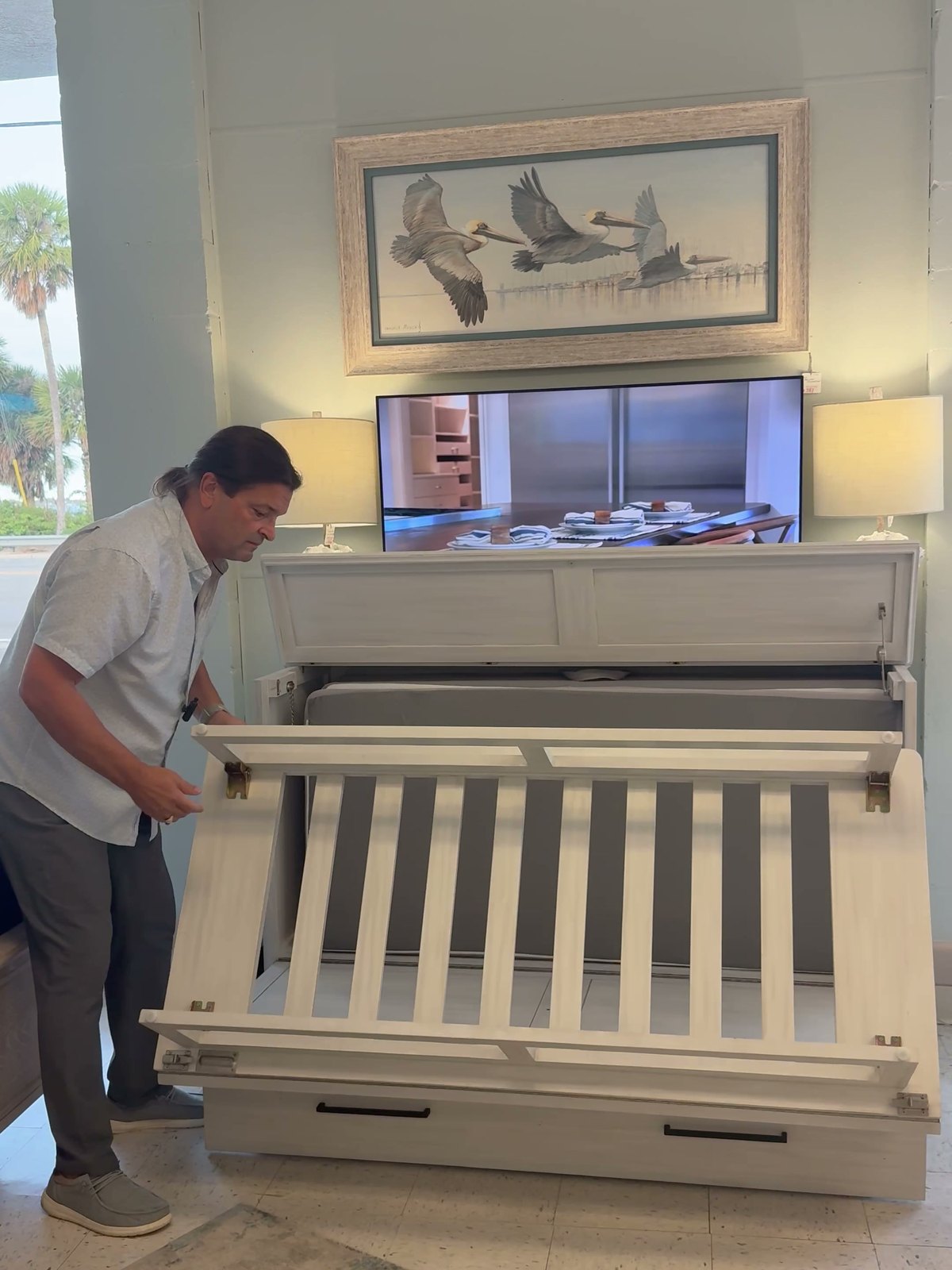
Open and close it twice. The second time is more informative than the first, because you already know what to expect and you will notice the motion instead of the novelty.
Listen at the halfway point. Creak, catch or a change in resistance mid-travel means something is binding. Smooth all the way through is what you want.
Look at the legs as they meet the floor. They should deploy positively and sit flat. Legs that need coaxing on a showroom floor will not improve in a bedroom.
Push down on a front corner with the bed open. A little flex is normal. A wobble, or a knock as the case shifts, is not.
Work the latch a few times. The latch is handled every single use and is the highest-cycle part on the whole piece.
Run a hand along the edges and the inside of the drawer. Finish quality on surfaces nobody sees tells you what the maker does when nobody is watching.
The honest part
A cabinet bed is furniture with moving parts. Treated as furniture, the mechanism is simple, the loads are modest, and there is not much in it to break. Treated as a trampoline by grandchildren, it is a folding mechanism with a finite number of cycles in it, like anything else that hinges.
Nothing lasts forever. What you are really buying is a design with few failure points, made from a material that holds a fastener, backed by somebody who will still answer the phone.
We keep thirteen cabinet beds on display, including both mechanism types, so you can open a hydraulic and a manual one within a minute of each other and feel the difference rather than read about it. We are at 1024 S Harbor City Blvd in Melbourne — directions here.
Specifications for every model are in the comparison table, and the category hub is the cabinet bed page. Related: how the mechanism works · what they cost · do they look cheap.
Eric